
Top Five Instatus Alternatives in 2026
Jun 09, 2026 | by openstatus | [alternative]

TL;DR
Instatus is a nice status page tool — and a great fit if you already have monitoring solved and just want a branded page on top. The moment you also need monitoring, monitoring-as-code, OpenTelemetry, or private probes, you start stretching it beyond what it was designed for.
If you're switching for the monitoring + status page bundle, look at openstatus, Datadog, or Betterstack. If you want a pure status page for serious incident comms, look at Atlassian Statuspage or Status.io. If you want open-source and self-hostable, openstatus is currently the only option on this list.
Why Teams Leave Instatus
Instatus is a genuinely good product. The status pages look great, they load fast, and the free tier is generous. We're not here to convince you it's broken — it isn't. But there are recurring reasons engineering teams outgrow it:
- Monitoring lives somewhere else. Instatus is built around ingesting signals from your existing monitoring stack (UptimeRobot, Pingdom, Datadog, etc.). For teams that want one tool — checks, alerts, and the public page — that split becomes friction.
- No monitoring-as-code. SRE and platform teams increasingly want checks defined in version control via Terraform, reviewable in a PR. Instatus doesn't ship a Terraform provider today.
- No agent / MCP story. If you're building with Claude, Cursor, or other coding agents, you want a tool that exposes its API through MCP so the agent can spin up monitors, open incidents, and post updates without screen-scraping. Instatus doesn't ship an MCP server.
- No OpenTelemetry export. If your observability stack is converging on OTel, you'll want your synthetic monitoring data to flow into it natively. Pure status-page tools rarely ship this.
- No private locations. Internal APIs, staging environments, and services behind a VPN need probes running inside your network. Status-page-first products almost never include this.
- Closed-source SaaS. For teams with strict data residency, audit, or compliance requirements, an open-source, self-hostable option is a hard requirement — not a nice-to-have.
If none of these apply to you, Instatus is probably fine. If two or more do, it's worth looking at the alternatives below.
What to Look For in an Instatus Alternative
Before scrolling to the comparison, get clear on what actually matters for your team. The five dimensions we'd evaluate against:
- Monitoring depth — is it included, and does it cover HTTP, TCP, ping, multi-step flows, and private endpoints?
- Configuration model — UI-only, API, or a real Terraform provider? How does it fit your existing workflow?
- Total cost at your size — not just the headline plan, but per-seat fees, private-page add-ons, and what breaks at scale.
- Incident workflow — subscriber channels, templates, severity, postmortems, integrations with your on-call tool.
- Hosting model — cloud-only or self-hostable? Where does your data live, and who has access?
The comparison below is structured around these.
Instatus Alternatives at a Glance
| Features | openstatus | Atlassian Statuspage | status.io | Datadog Status Page | Betterstack |
|---|---|---|---|---|---|
| Status Page | |||||
| Private Status Page | $30/m | $99/m | $349/m | ✅ | Add-on $42/m |
| Team Members | Unlimited | $20+/seat | 50 for $349/m | $42/seat | $29/seat |
| Custom Style | Theme Store | ✅ | ✅ on $349 | ✅ | $12 per page/month |
| Monitoring | |||||
| Built-in Monitoring | ✅ | ❌ | ❌ | ✅ | ✅ |
| Monitoring As Code | ✅ Terraform | ❌ | ❌ | ✅ Terraform | ✅ Terraform |
| OpenTelemetry | ✅ | ❌ | ❌ | ✅ | ❌ |
| Private Locations | ✅ | ❌ | ❌ | ✅ | ❌ |
| Agent / Automation | |||||
| MCP Server | ✅ | ❌ | ❌ | ✅ | ❌ |
| Other | |||||
| Open-Source | ✅ | ❌ | ❌ | ❌ | ❌ |
| Self-Hosting | ✅ | ❌ | ❌ | ❌ | ❌ |
Prices reflect publicly listed plans at time of writing and change frequently — always confirm with the vendor before deciding.
openstatus vs Instatus, feature by feature
| Feature | openstatus | Instatus |
|---|---|---|
| Open-source | Yes | No |
| Self-hosted | Yes | No |
| Scheduling strategy | Parallel (all regions at once) | Sequential |
| Multi-region | 28 regions | ~4 regions |
| Monitoring as code | Yes | No |
| OpenTelemetry export | Yes | No |
| Developer tooling | CLI, Terraform, GitHub Actions | No |
| Status page | Yes | Yes |
| Unlimited subscribers | Yes | Yes |
| Team members | Unlimited | Unlimited |
openstatus vs Instatus pricing
| openstatus | Instatus | |
|---|---|---|
| Free plan | 1 monitor, 1 status page | 1 status page (no custom domain) |
| Starter/paid | $30/mo | $20/mo |
| What's included | 20 monitors + 28 regions + status page + unlimited team members | 1 custom-domain status page + basic monitoring |
| Additional status pages | $20/mo each | Included in higher plans |
Instatus is $10/month cheaper on the base plan, but it does not include the depth of monitoring openstatus offers. If you're already paying for a separate monitoring tool alongside Instatus, openstatus replaces both at a lower combined cost.
The Five Alternatives
1. openstatus — best for developer teams that want one tool
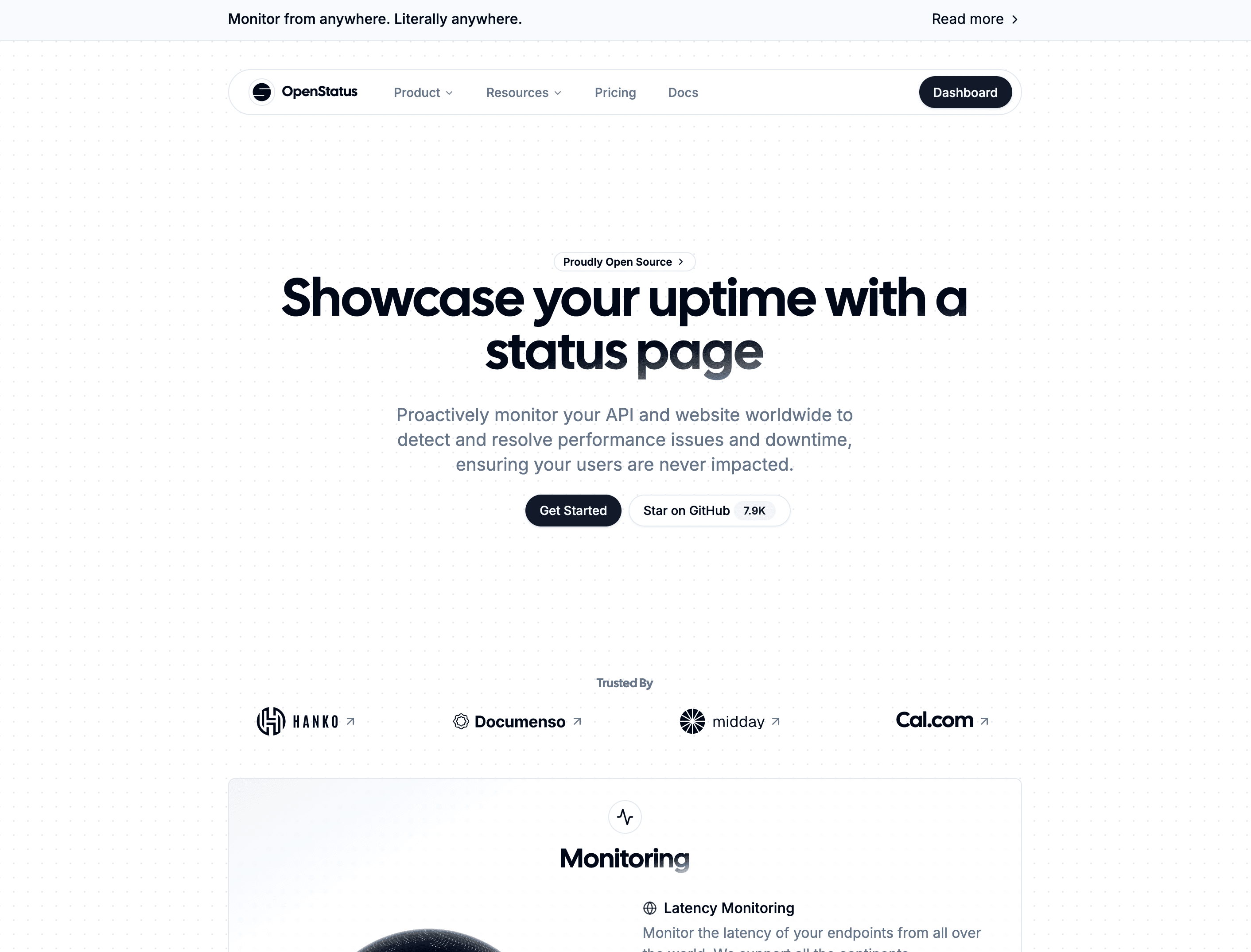
openstatus is an open-source synthetic monitoring and status page platform built for engineering teams. It runs synthetic checks from multiple regions, exports OpenTelemetry, and powers a public or private status page from the same workspace.
The differentiator versus Instatus is that the monitoring is the product — you don't bolt it on. Define your checks through the Terraform provider, plan and apply, and the platform reconciles:
resource "openstatus_http_monitor" "api" {
  name        = "API Health Check"
  url         = "https://api.example.com/health"
  periodicity = "5m"
  regions     = ["fly-iad", "fly-ams", "fly-syd"]

  status_code_assertions {
    target     = 200
    comparator = "eq"
  }
}
When a check fails, the status page can update automatically or wait for a human, depending on your policy.
- Monitoring: HTTP, TCP, ping, multi-step, and private locations via lightweight agents inside your network.
- Config: First-class Terraform provider so your monitors live in version control next to the rest of your infra.
- Observability: Native OpenTelemetry export to your existing backend.
- Agent-friendly: Ships an MCP server so Claude Code, Cursor, and other coding agents can create monitors, manage incidents, and read status directly. Connect it to Claude Code or Claude Desktop in minutes.
- Pricing: Paid plans start at $30/month with unlimited team members; free tier available; self-host for $0.
- Trade-offs: Younger than Atlassian Statuspage; smaller ecosystem of pre-built integrations than Datadog.
Best for: Developer-led teams that want monitoring, status pages, and incident comms in one open-source tool — and want their infrastructure config in git.
2. Atlassian Statuspage — best for enterprise incident comms
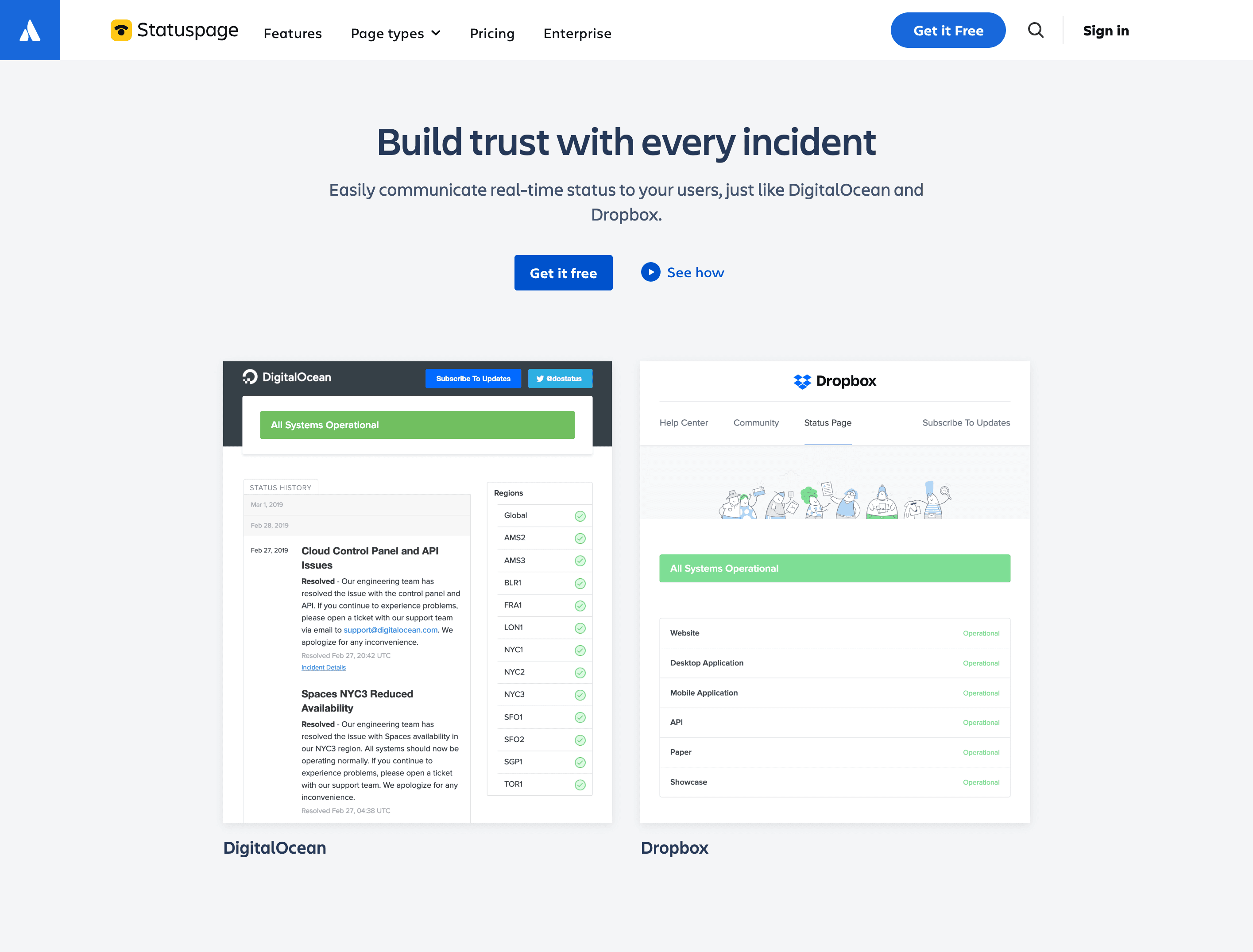
Atlassian Statuspage is the original and most mature status page product. It's deeply focused on incident communication — subscriber management, templates, audit trails, and integrations with Jira and Opsgenie are all first-class.
It does not include monitoring. You bring your own (Datadog, New Relic, Atlassian's own monitoring, etc.) and pipe events in. If incident comms is the hard problem and monitoring is already solved elsewhere, Statuspage's depth here is hard to match.
- Strengths: Battle-tested workflows, deep subscriber tooling (Email, SMS, Webhook, Slack, Microsoft Teams), Jira / Opsgenie integration.
- Trade-offs: No monitoring; pricing climbs quickly once you need private pages or large subscriber counts; UI feels dated next to newer entrants.
Best for: Larger organizations that already run on Atlassian, have monitoring sorted, and need a proven incident-communication platform.
3. Status.io — best for pure status comms without monitoring
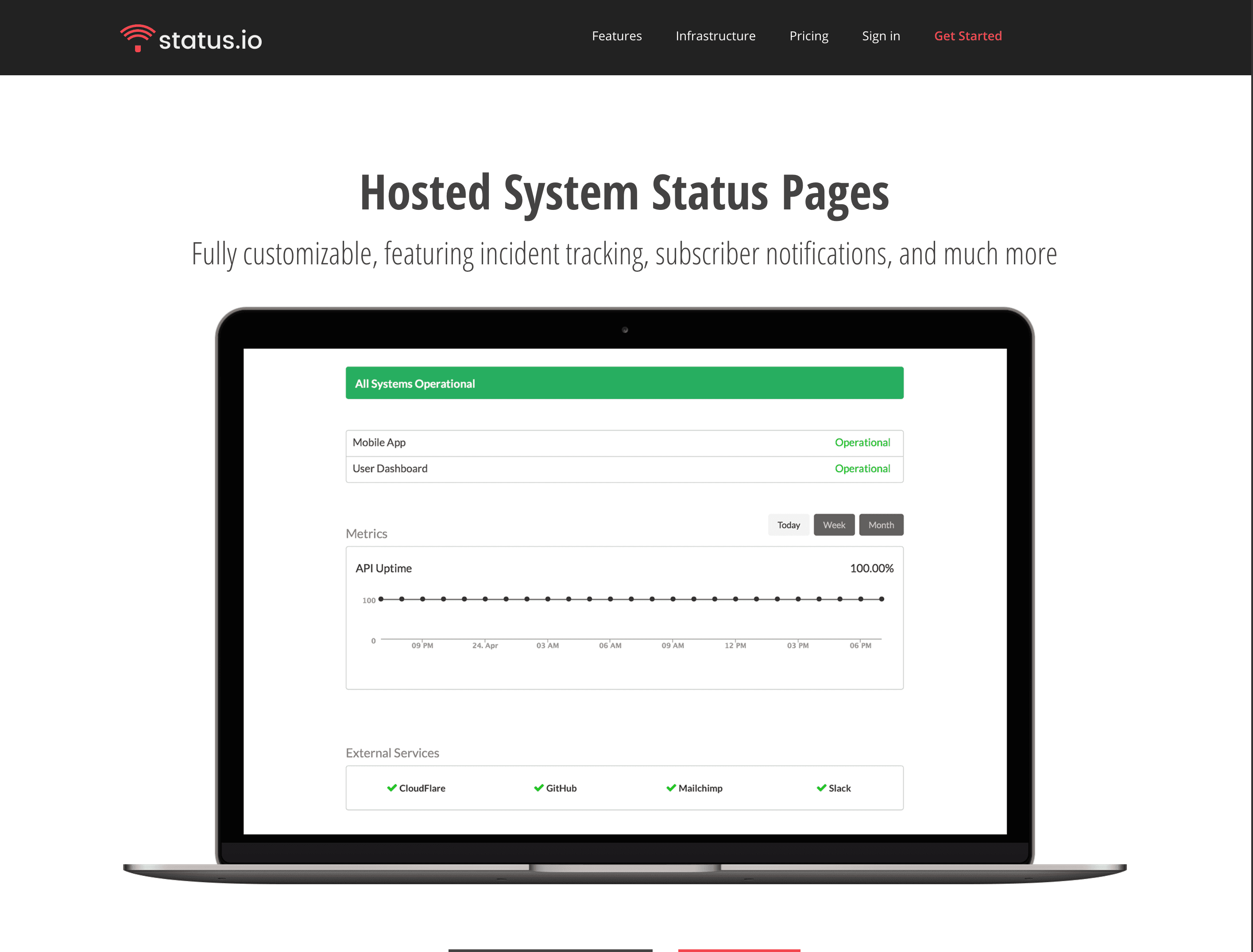
Status.io is a long-standing, cloud-based status page provider. It's intentionally narrow: status communication and incident management, no monitoring. Customers like Docker have used it for years.
If you specifically want a tool that does one thing and stays out of your monitoring stack, Status.io is a sensible choice. The flip side is that the headline pricing for advanced features (private pages, full customization) starts at $349/month, which is a steep jump from Instatus.
- Strengths: Focused incident management, broad subscriber channels (Email, SMS, Webhooks, Slack).
- Trade-offs: No built-in monitoring; advanced features gated behind higher tiers; less modern UI than newer competitors.
Best for: Organizations that want a dedicated status-page service decoupled from monitoring and don't mind the price step for advanced features.
4. Datadog Status Page — best if you already live in Datadog
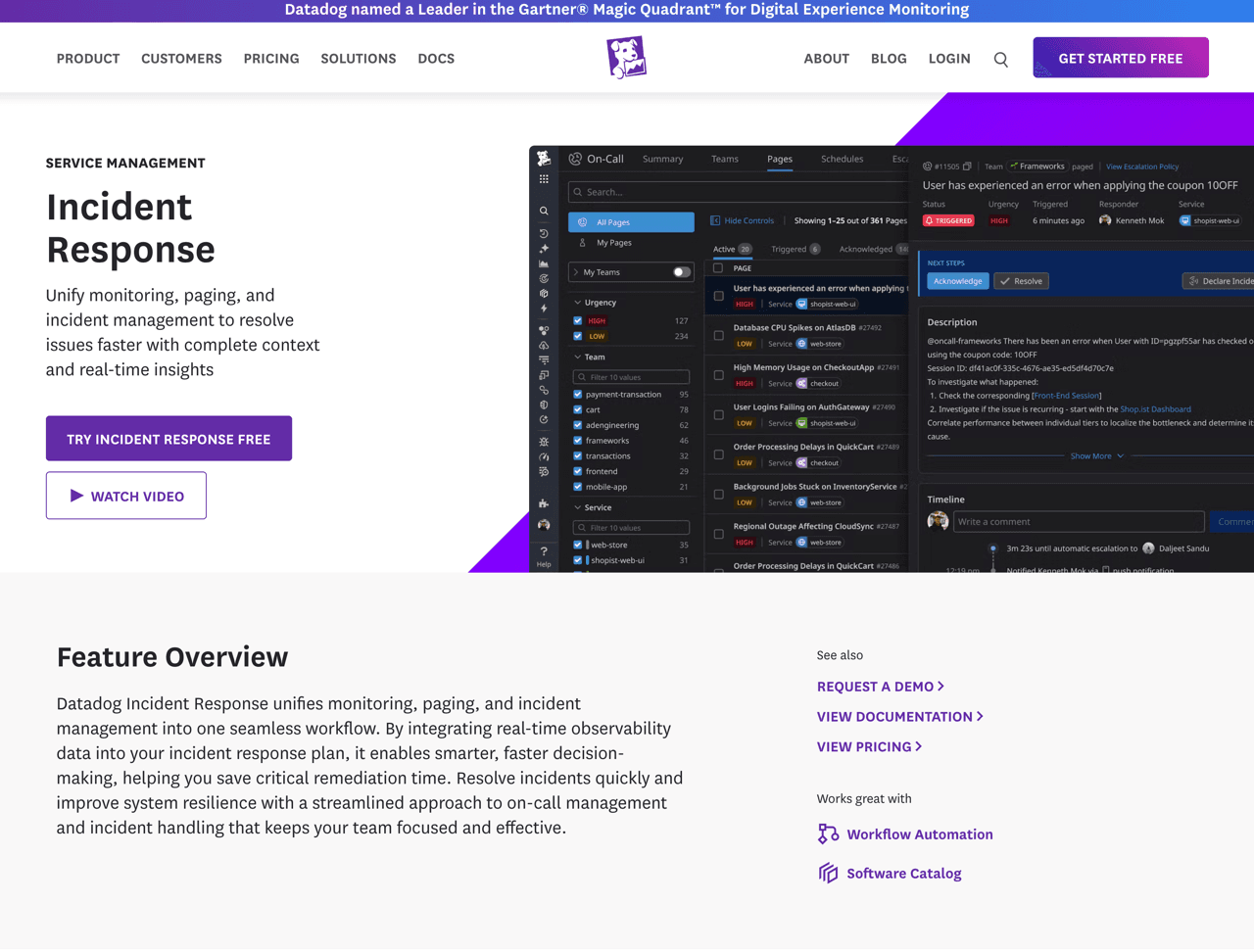
Datadog Status Page is the natural extension if Datadog is already your observability backbone. It links incidents directly to monitors, logs, and traces — meaning the page reflects the same source of truth your on-call team is already looking at.
You're paying Datadog prices and committing further to the ecosystem, so this only makes sense if you're already in. As a standalone Instatus replacement for a small team it's almost always overkill.
- Strengths: Tight integration with Datadog monitors, logs, traces, and incident management.
- Trade-offs: Per-seat pricing adds up; vendor lock-in to Datadog; not a fit if you're not already a Datadog customer.
Best for: Existing Datadog-heavy organizations that want one less vendor and tighter signal-to-page automation.
5. Betterstack — best for solo devs and small teams on a free tier
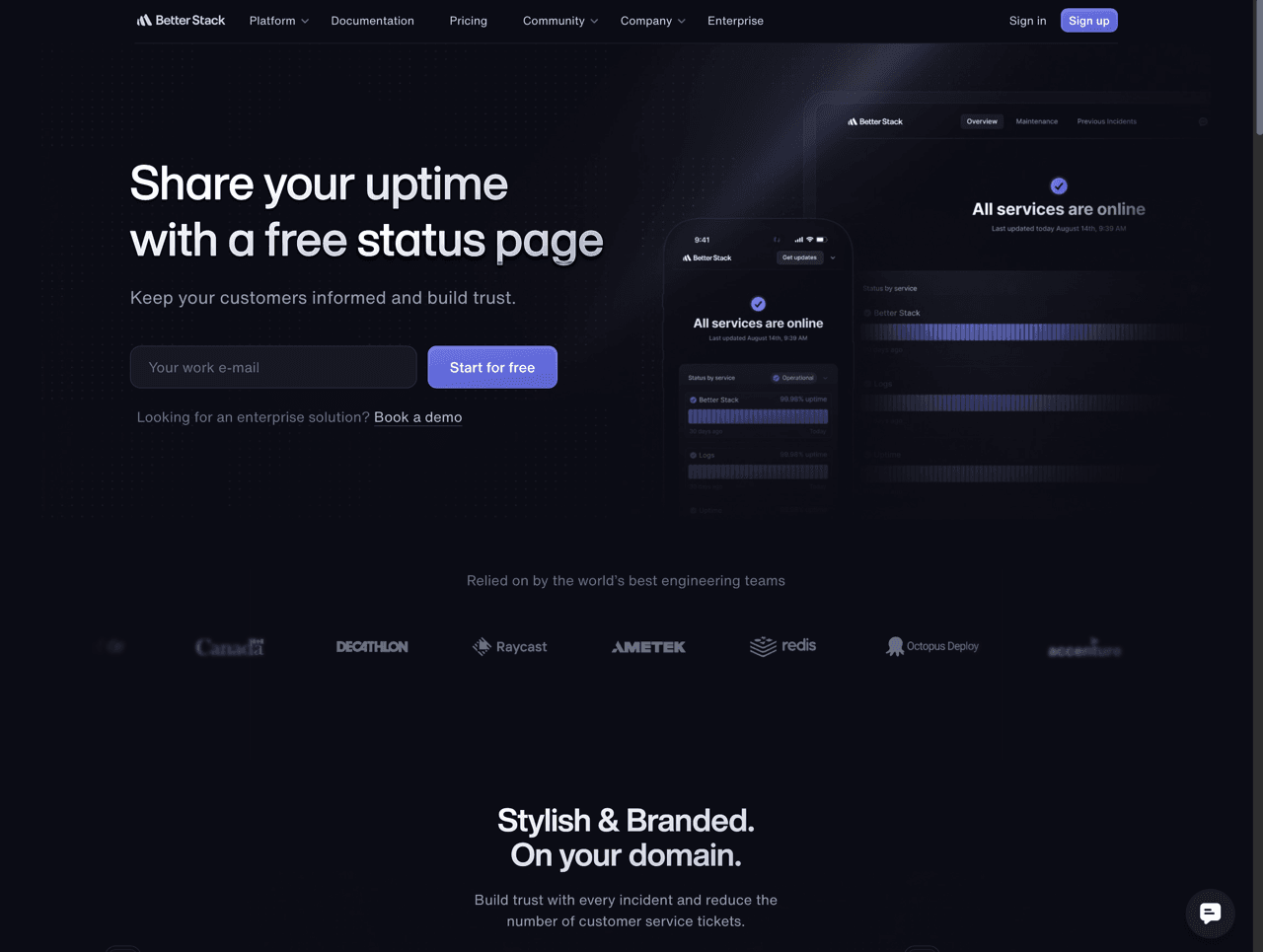
Betterstack bundles uptime monitoring, on-call scheduling, incident management, and status pages into one product. The free tier is genuinely usable for personal projects and small side businesses, and Terraform support makes it a credible option for infrastructure teams.
The catch is per-page and per-seat add-ons: custom styling is a $12-per-page-per-month upcharge, the private status page lives behind a $42 add-on, and seats scale at $29 each. The bundle gets pricier than it looks once you're past the free tier.
- Strengths: All-in-one (monitoring + on-call + status), generous free tier, Terraform provider.
- Trade-offs: Add-on pricing for styling and private pages; no OpenTelemetry; no private locations; closed-source.
Best for: Solo developers and small teams whose needs fit comfortably inside the free tier, or who value the on-call + status-page bundle.
Pick the Right One
A quick decision shortcut:
- You want one tool, in git, open-source → openstatus
- Enterprise incident comms, monitoring already solved → Atlassian Statuspage
- Just a status page, nothing else → Status.io
- Already on Datadog → Datadog Status Page
- Solo dev, generous free tier, all-in-one → Betterstack
Migrating from Instatus
If you're considering openstatus specifically, the migration is designed to be painless. The importer pulls in:
- Components and component groups
- Incidents, with their full update history
- Scheduled maintenances
- Email subscribers
Paste your Instatus API key, preview the diff, and confirm. Monitors are set up separately via the Terraform provider — that's the part where you get the benefit of moving. Full walkthrough in our Instatus migration guide.
For the other alternatives, migration is typically a manual rebuild of components and a CSV export of subscribers — check each vendor's docs for the current state.
Related Guides
- How openstatus Compares to Other Status Page Tools — full feature head-to-head
- Best Hosted Status Page Tools in 2026 — the wider SaaS landscape ranked
- Best Incident Communication Tools in 2026 — when you also need internal coordination
- Top Five Atlassian Statuspage Alternatives in 2026 — switching from Atlassian instead
- How to migrate from Instatus to openstatus — the step-by-step move
Need Help or Have Questions?
If you need help along the way, feel free to join our Discord community, check our documentation for more information, or reach out to us via email.
Frequently asked questions
Is openstatus a good Instatus alternative?
Yes, especially if you need real uptime monitoring alongside your status page. Instatus is a status-page-first product with basic HTTP monitoring added later. Openstatus was built around monitoring first — checking from 28 global regions simultaneously — with status pages as a native part of the product, not a bolt-on.
How does openstatus pricing compare to Instatus?
Instatus starts at $20/month for one custom-domain status page. Openstatus starts at $30/month and includes uptime monitoring from 28 regions, unlimited team members, and monitoring-as-code tooling. If you need both monitoring and a status page, openstatus covers both in one plan.
How do I migrate from Instatus to an alternative?
openstatus offers a one-click importer that automatically transfers your components, component groups, incidents (with all updates), maintenances, and email subscribers. Paste your Instatus API key, preview what will be imported, and confirm. See our step-by-step migration guide for details.
Which Instatus alternative is most cost-effective for small teams?
openstatus and Betterstack are the most cost-effective for small teams. openstatus includes monitoring and unlimited team members from $30/month, while Betterstack has a generous free tier that works well for solo developers. Both are typically cheaper than scaling on Instatus once you outgrow its free plan.
Can I use these alternatives without built-in monitoring?
Yes. Status.io and Atlassian Statuspage focus purely on status communication. openstatus, Datadog, and Betterstack include monitoring but also accept manual incident updates and webhooks, so you can keep your existing monitoring tools if you prefer.
Do any Instatus alternatives support self-hosting?
openstatus is the only open-source option on this list that supports self-hosting, giving you full control over your data and infrastructure. Instatus, Atlassian Statuspage, Status.io, Datadog, and Betterstack are cloud-hosted SaaS only.
Why do teams switch away from Instatus?
The most common reasons are: needing built-in monitoring instead of stitching together third-party probes, wanting monitoring-as-code via Terraform, needing OpenTelemetry export, requiring private locations for internal services, or wanting an open-source solution for compliance and data residency.