How to Deploy a Private Probe on Cloudflare Containers
Problem
You need to monitor internal services that are not accessible from the public internet, or you want to run checks from your own infrastructure for compliance or performance reasons. You need a lightweight, serverless way to run these monitoring probes without managing virtual machines.
Solution
Deploy the openstatus private location probe as a serverless container using Cloudflare Containers. This allows you to run monitoring checks from within your own network infrastructure, managed by Cloudflare. This guide will walk you through the entire process, from creating the private location in openstatus to deploying the container.
The code for the Cloudflare Worker template is available on GitHub.
Prerequisites
- A Cloudflare account
- An openstatus account
pnpmanddockerinstalled on your local machine
Step-by-step guide
1. Create a private location in openstatus
First, you need to create a private location in your openstatus workspace to get an access key.
- Go to the openstatus dashboard.
- Navigate to Settings > Private Locations.
- Click Create Private Location.
- Give it a human-readable name (e.g., "Cloudflare-EU").
- Copy the generated token and save it somewhere secure.
- Click Submit to save the new private location.
2. Set up the Cloudflare project
Next, create a new Cloudflare project using the containers template.
pnpm create cloudflare@latest --template=cloudflare/templates/containers-template
3. Pull and tag the probe Docker image
Pull the official openstatus private location image from the GitHub Container Registry (ghcr.io). You must specify the linux/amd64 platform, as this is what Cloudflare Containers supports.
# Pull the image
docker pull --platform linux/amd64 ghcr.io/openstatushq/private-location:latest

# Tag the image for Cloudflare (you cannot use the 'latest' tag)
docker tag ghcr.io/openstatushq/private-location:latest openstatus-private-location:v1
4. Push the image to Cloudflare Container Registry
Push the tagged image to your Cloudflare account's container registry.
pnpm wrangler containers push openstatus-private-location:v1
5. Configure wrangler.toml
Now, configure your Cloudflare project to use the container and run it on a schedule.
- Open the
wrangler.tomlfile. - Add a
[containers]section to link the image you pushed. ReplaceGENERATED_IDwith the actual ID from the previous step's output.[containers] image = "registry.cloudflare.com/GENERATED_ID/openstatus-private-location:v1" - Add a
triggerssection to run the worker on a cron schedule. This keeps the container alive, as Cloudflare Containers automatically scales to zero.triggers = { cron = ["*/2 * * * *"] } # Runs every 2 minutes
6. Configure the worker
Update the worker script (index.ts) to start the container with the correct environment variables.
- Set the
sleepAftervalue to control how long the container runs after being invoked.sleepAfter = "150s"; - Update the
scheduledfunction to pass your openstatus key to the container.async scheduled(_controller: any, env: Env) { try { const container = getContainer(env.MY_CONTAINER); await container.start({ envVars: { OPENSTATUS_KEY: env.OPENSTATUS_KEY, }, }); } catch (e) { console.error("Error in scheduled task:", e); } return new Response("ok"); },
7. Add your openstatus key as a secret
Securely provide your private location token to the Cloudflare worker.
# Paste the token you saved in Step 1 when prompted
pnpm wrangler secret put OPENSTATUS_KEY
8. Deploy the application
Finally, deploy the worker and container to Cloudflare.
pnpm wrangler deploy
Your private location probe is now running on Cloudflare Containers and will start picking up monitoring jobs from your openstatus workspace.
Verify the deployment
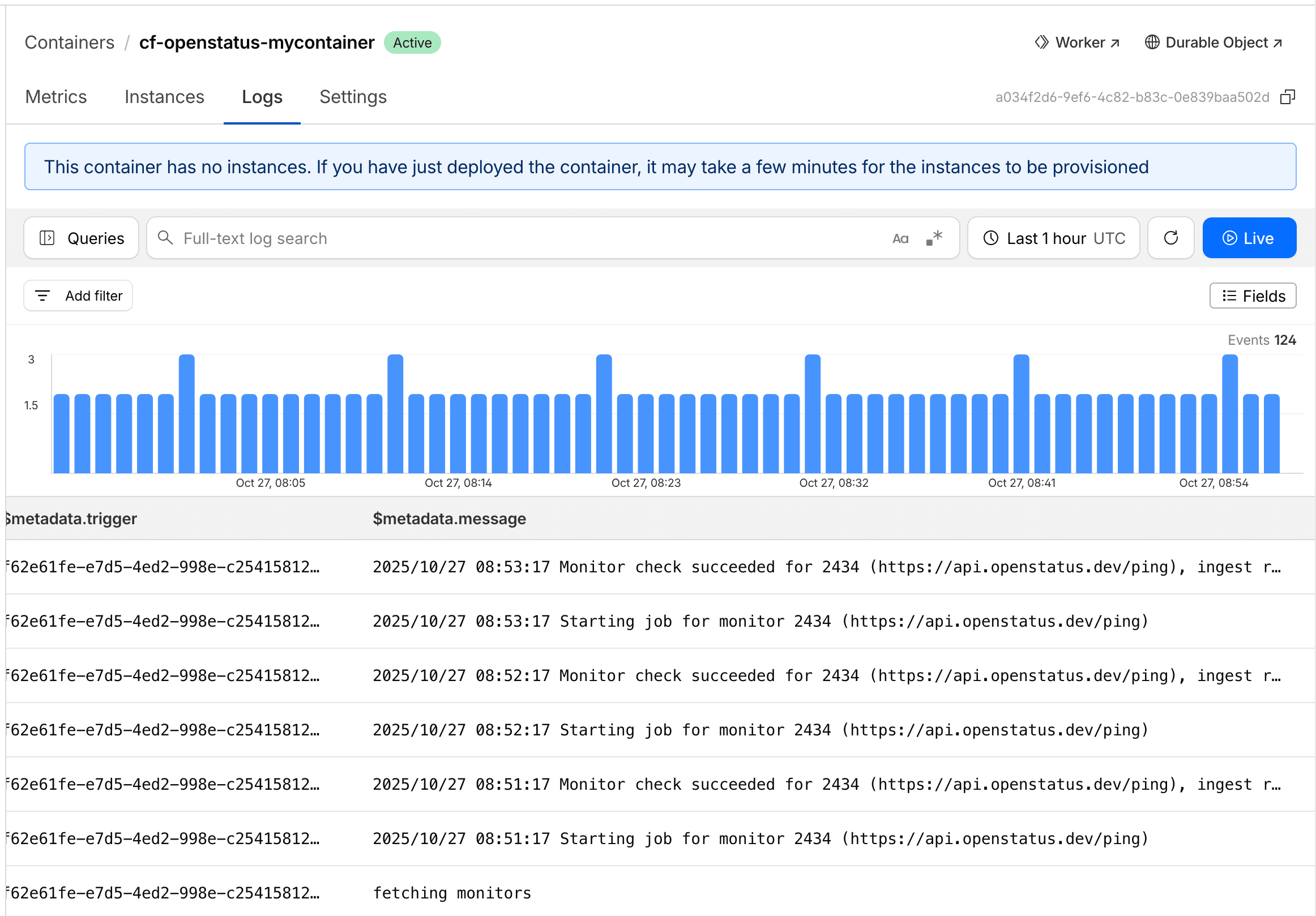
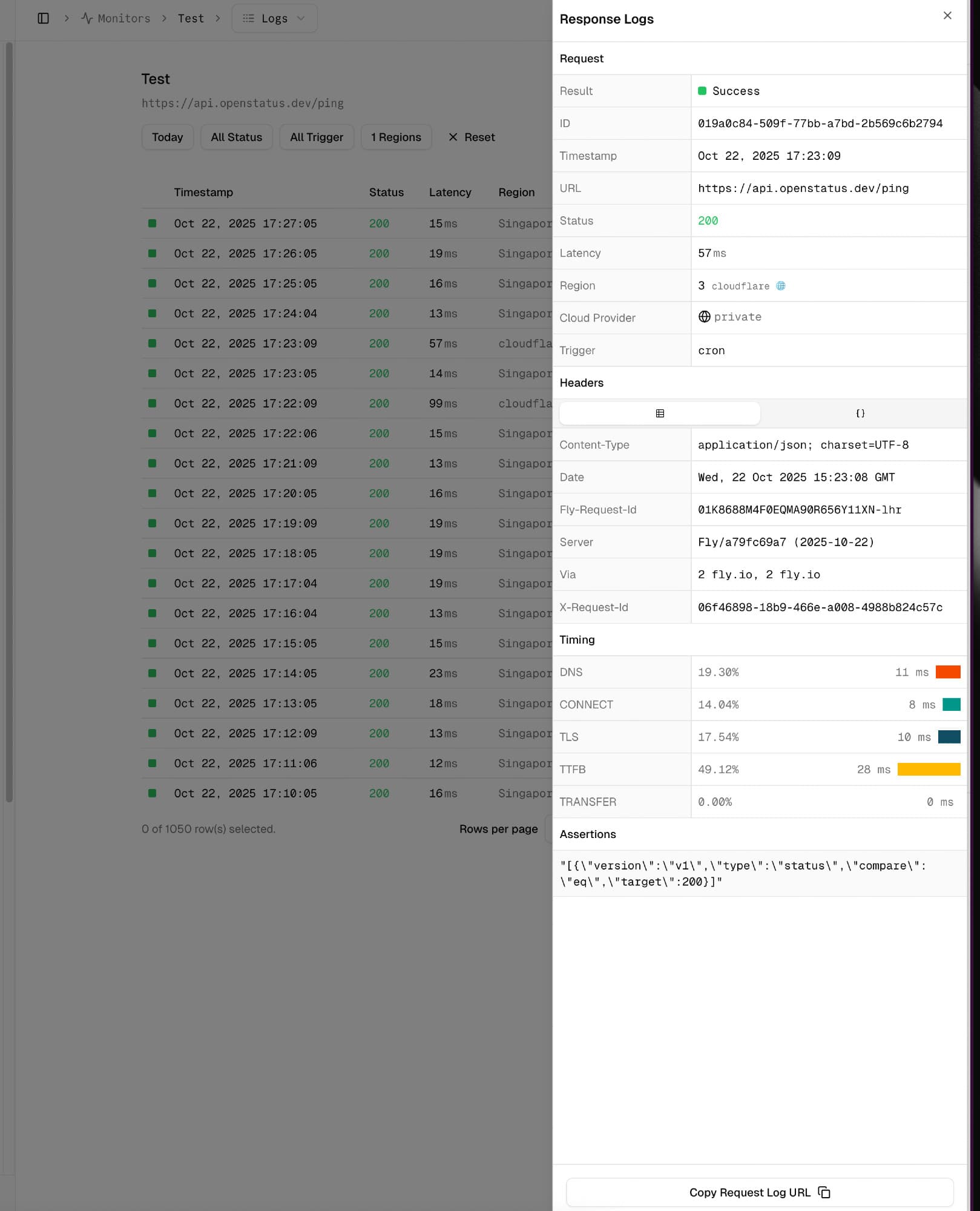
You can check the logs of your Cloudflare Worker to see the probe in action. In your openstatus dashboard, the private location's status flips to active once the agent reports, and checks from it start appearing in your monitors' response logs.