
Create a Status Page
What you'll learn
| Time | ~5 minutes |
| Level | Beginner |
| Prerequisites | openstatus account, at least one monitor |
In this tutorial, you'll create a public status page to communicate your service's health to users. A status page is a transparent way to show real-time uptime information and keep your users informed during incidents.
Prerequisites
- An openstatus account
- At least one monitor created (see Create Your First Monitor)
What you'll build
By the end of this tutorial, you'll have:
- A public status page showing your service health
- Monitors displayed on your status page
- Understanding of privacy and security options
Get started
1. Create the status page
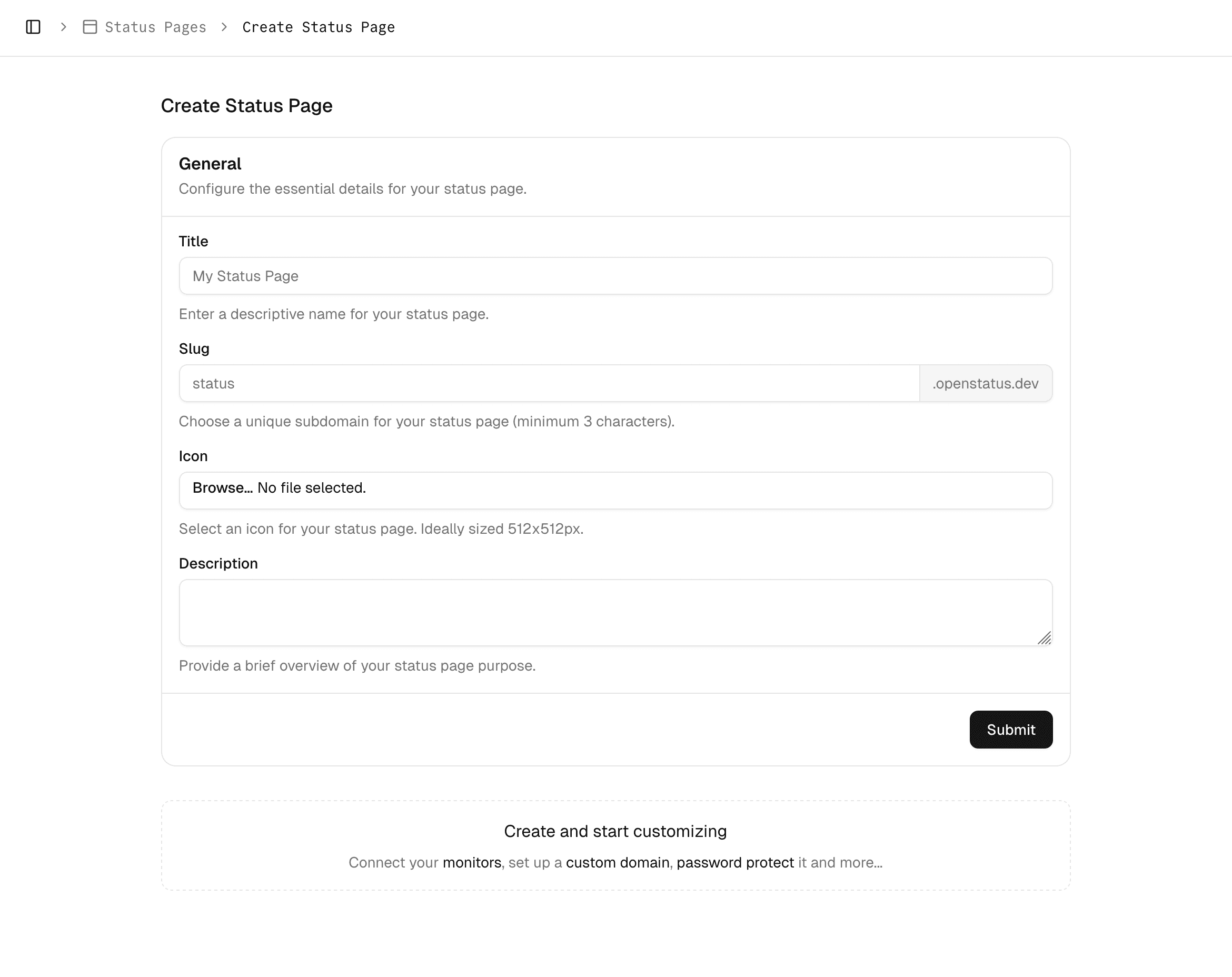
Navigate to the Status Pages page from the sidebar and click the Create Status Page button. This will open a new configuration screen.
2. Configure the status page
Fill in the basic details for your status page:
- Title: A name for your status page (e.g., "Acme Status" or "API Health")
- Slug: The URL path for your status page (e.g.,
acmecreatesacme.openstatus.dev)
Add monitors
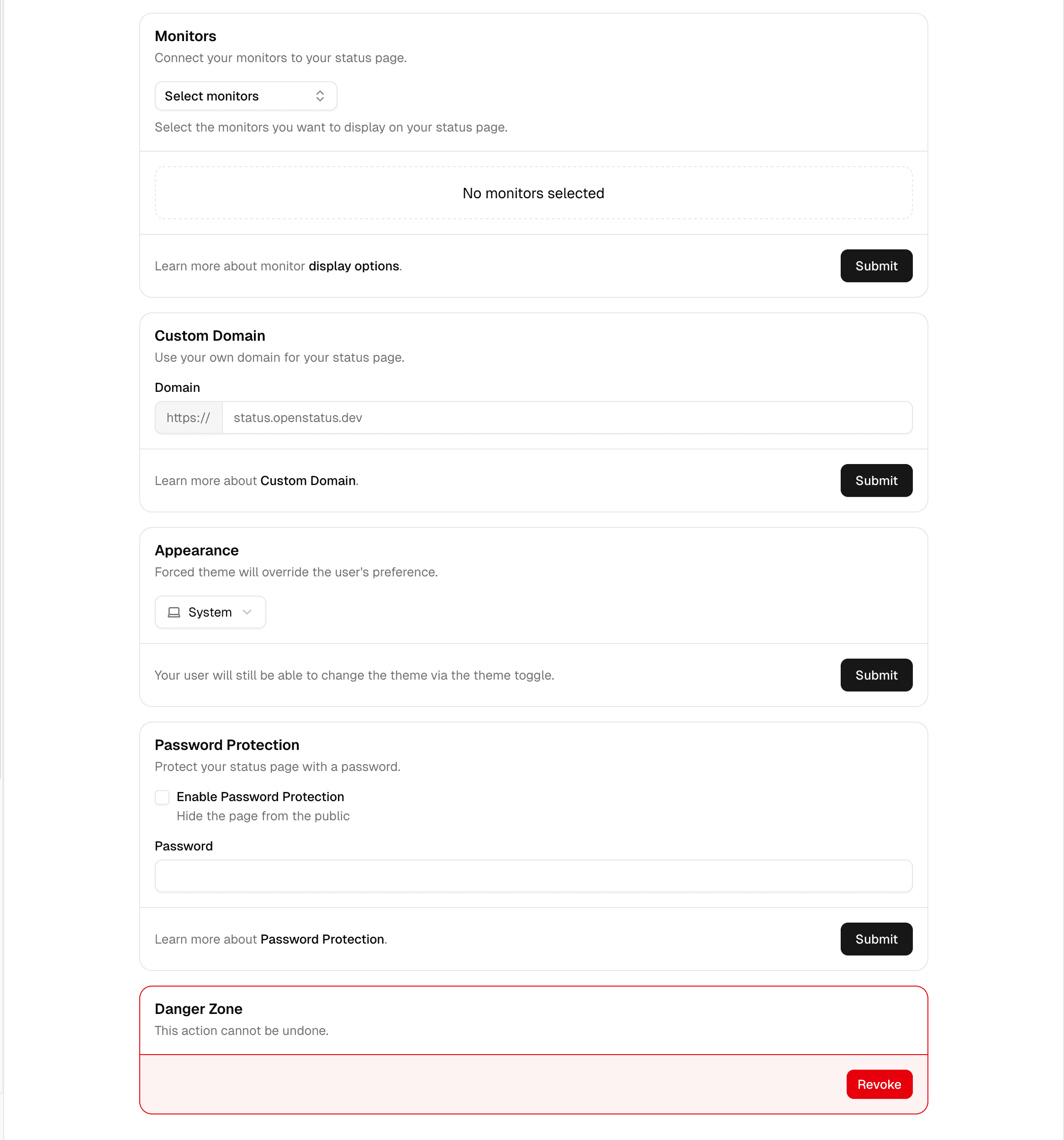
Select the monitors you want to display on your status page. Each monitor will show as a separate service with its own uptime bar. You can add multiple monitors to give users a complete picture of your infrastructure health.
Custom domain
You can use your own domain (e.g., status.yourdomain.com) instead of the default *.openstatus.dev subdomain. To set this up:
- Enter your custom domain in the Custom Domain field
- Configure DNS records based on your domain type:
- Subdomain (e.g.,
status.yourdomain.com): Add a CNAME record pointing tocname.vercel-dns.com - Apex domain (e.g.,
yourdomain.com): Add an A record pointing to76.76.21.21
- Subdomain (e.g.,
- Wait for DNS propagation (usually a few minutes, up to 48 hours)
- If your domain is already registered on another Vercel project, you may need to add a TXT record to verify ownership. The dashboard will show the exact TXT values if this step is required.
The dashboard will show you the exact DNS records to configure after you save your custom domain.
See the Status Page Reference for detailed DNS configuration instructions.
Password protection
Enable password protection to restrict access to your status page. This is useful for internal status pages that should only be visible to your team or specific customers. Enter a password, and visitors will be prompted to authenticate before viewing the page.
Checkpoint: After saving, click the link to your status page (shown at the top of the settings). You should see your monitors listed with uptime bars.
What you've accomplished
Great work! You've successfully:
- ✅ Created your first status page
- ✅ Added monitors to display service health
- ✅ Learned about custom domains and password protection
What's next?
Now that you have a basic status page, you can:
- Configure Your Status Page - Customize appearance and add more features
- Building Trust with Status Pages - Learn how to communicate effectively
Learn more
- Status Page Reference - Complete configuration options
- Understanding Uptime Values - How uptime is calculated